CLOTHING OF INDIAN CULTURE
ClothinG
Fundamental article: Clothing in India
Representation of various styles of Sari, Gagra Choli and Shalwar Kameez worn by ladies in India.
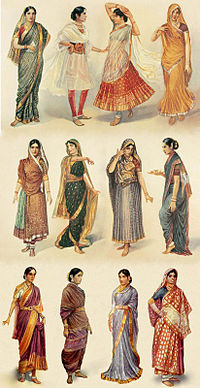
Customary apparel in India significantly fluctuates crosswise over various parts of the nation and is affected by nearby culture, geology, atmosphere and rustic/urban settings. Prominent styles of dress incorporate hung articles of clothing, for example, sari for ladies and dhoti or lungi or panche (in Kannada) for men. Sewed garments are additionally mainstream, for example, churidar or salwar-kameez for ladies, with dupatta (long scarf) tossed over shoulder finishing the outfit. Salwar is regularly baggy, while churidar is a more tightly cut.
Indian ladies idealize their feeling of fascinate and design with make up and adornments. Bindi, mehendi, hoops, bangles and other gems are normal. On uncommon events, for example, wedding services and celebrations, ladies may wear merry hues with different decorations made with gold, silver or other provincial stones and jewels. Bindi is frequently a fundamental part of a Hindu lady's make up. Worn on their brow, some consider the bindi as a favorable stamp. Generally, the red bindi was worn just by hitched Hindu ladies, and shaded bindi was worn by single ladies, yet now all hues and sparkle has turned into a piece of ladies' mold. A few ladies wear sindoor – a conventional red or orange-red powder (vermilion) in the separating of their hair (privately called mang). Sindoor is the customary sign of a wedded lady for Hindus. Single Hindu ladies don't wear sindoor; neither do more than 1 million Indian ladies from religions other than Hindu and freethinkers/nonbelievers who might be married.The make up and dress styles vary provincially between the Hindu gatherings, and furthermore by atmosphere or religion, with Christians favoring Western and Muslim inclining toward the Arabic styles. For men, sewed adaptations incorporate kurta-pajama and European-style pants and shirts. In urban and semi-urban focuses, men and ladies of every religious foundation, can regularly be found in pants, pants, shirts, suits, kurtas and assortment of other fashions.